English
What is plain woven fabric called?
Content
Direct Answer: The Many Names of Plain Woven Fabric
Plain woven fabric is most commonly referred to by its technical name, calico weave or tabby weave. In the fashion and textile industry, it is also frequently called linen weave when the fibers resemble flax, or simply "1/1 weave" in manufacturing contexts. Depending on the weight, finish, and fiber used, this versatile woven fabric can take on specific commercial names such as poplin, chiffon, canvas, or percale.
Understanding the Basic Structure of Plain Weaving
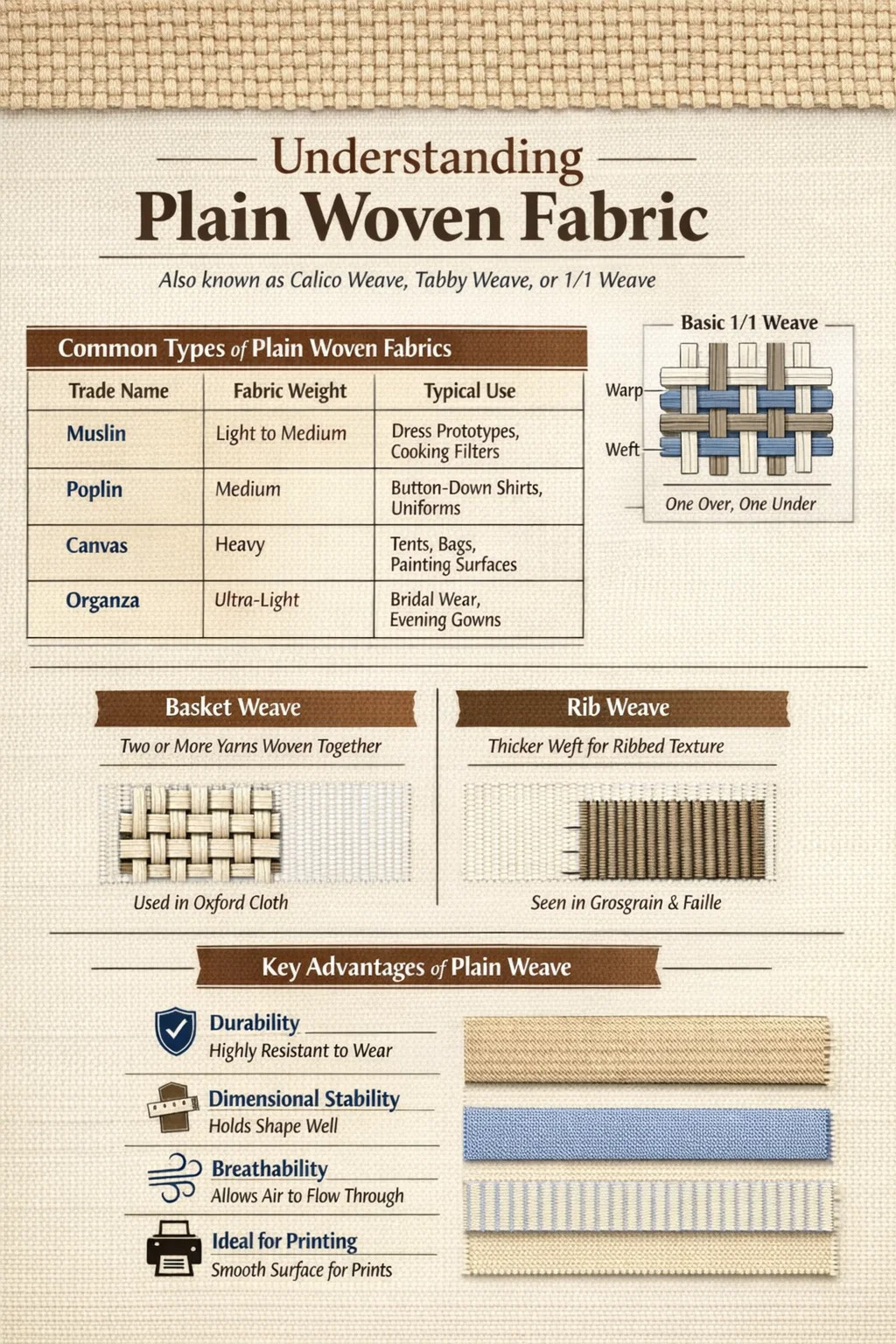
At its core, the plain woven fabric is defined by the simplest interlacing pattern possible. In this method, the warp (longitudinal) and weft (transverse) yarns cross over and under each other in an alternating sequence. Every weft yarn goes over one warp yarn and then under the next, creating a checkerboard pattern that looks the same on both sides.
This "one-up, one-down" structure provides the maximum number of interlacing points. This is why a plain woven fabric is generally tougher and more resistant to abrasion than more complex weaves like satin. Because the yarns are locked tightly together, the fabric is less likely to fray or slip, making it the bedrock of the garment and home textile industries.
Common Market Names for Plain Woven Fabric
While the construction remains the same, the terminology changes based on the yarn's density and raw material. Here are the most prominent names you will encounter when shopping for this woven fabric:
| Trade Name | Fabric Weight | Typical Use |
|---|---|---|
| Muslin | Light to Medium | Dress prototypes and cooking filters |
| Poplin | Medium | Button-down shirts and uniforms |
| Canvas | Heavy | Tents, bags, and painting surfaces |
| Organza | Ultra-Light | Bridal wear and evening gowns |
Variations: Beyond the Standard 1/1 Weave
Not all plain woven fabric types are perfectly flat. By varying the thickness or the number of yarns, manufacturers create unique textures that still fall under the plain weave umbrella.
The Basket Weave
In a basket weave, two or more yarns are bundled together and woven as one. This creates a larger, more visible "square" pattern. It remains a plain woven fabric because the basic crossing logic is identical. It is famously used in Oxford cloth for men's shirts, providing better breathability due to the slightly larger gaps between yarn bundles.
The Rib Weave
By using a significantly thicker weft yarn against fine warp yarns, a "ribbed" effect is created. This produces a woven fabric like Grosgrain or Faille. These are often used for ribbons or stiff collars where structural integrity is a priority.
Key Performance Characteristics
Why is this specific type of weaving so dominant? It offers a unique set of benefits that neither knit nor more decorative weaves can match:
- Dimensional Stability: Plain woven fabric does not stretch significantly. This makes it ideal for tailored clothing where crisp lines are required.
- Durability: With the highest frequency of yarn interlacing, it withstands repeated washing and heavy wear.
- Printing Surface: Because the surface is relatively flat compared to twill or jacquard, it is the best woven fabric for intricate prints and digital textile designs.
- Breathability: Depending on the fiber, the 1/1 structure allows air to move through the gaps effectively, which is why it is preferred for summer bedding (Percale).
Practical Applications in Daily Life
You likely encounter plain woven fabric every hour of your day. It is the material of choice for kitchen towels because it dries quickly and doesn't snag on utensils. In your wardrobe, it appears as the crisp cotton of a formal shirt or the airy silk of a summer blouse. Even in industrial settings, high-strength plain weaving using synthetic fibers like nylon or polyester creates the rugged material used for backpacks and safety harnesses.
When choosing a project, remember that while it may be "plain" by name, the variety of finishes—from the rough, unbleached texture of calico to the sheer elegance of voile—makes it the most adaptable woven fabric in the world.
 PREV
PREV