English
What Is the Name of Soft Woven Fabric? Types & Uses Explained
Content
- 1 The Most Common Names for Soft Woven Fabric
- 2 Velvet: The Classic Name in Soft Woven Fabric
- 3 Satin and Charmeuse: Soft Woven Fabrics with Silky Surfaces
- 4 Chiffon: A Lightweight Soft Woven Fabric for Flowing Garments
- 5 Flannel and Brushed Cotton: Soft Woven Fabrics Built for Warmth
- 6 Muslin, Lawn, and Batiste: Soft Lightweight Woven Fabrics for Fine Work
- 7 Crepe: The Soft Woven Fabric with a Distinctive Crinkled Surface
- 8 Chambray and Soft Denim: Casual Soft Woven Fabrics for Everyday Wear
- 9 Jacquard and Brocade: Structured Soft Woven Fabrics with Woven-In Patterns
- 10 How Fiber Content Affects the Softness of Woven Fabric
- 11 Woven Fabric vs. Knit Fabric: Understanding the Difference in Soft Textiles
- 12 Caring for Soft Woven Fabrics to Maintain Their Quality
- 13 Choosing the Right Soft Woven Fabric for Your Project
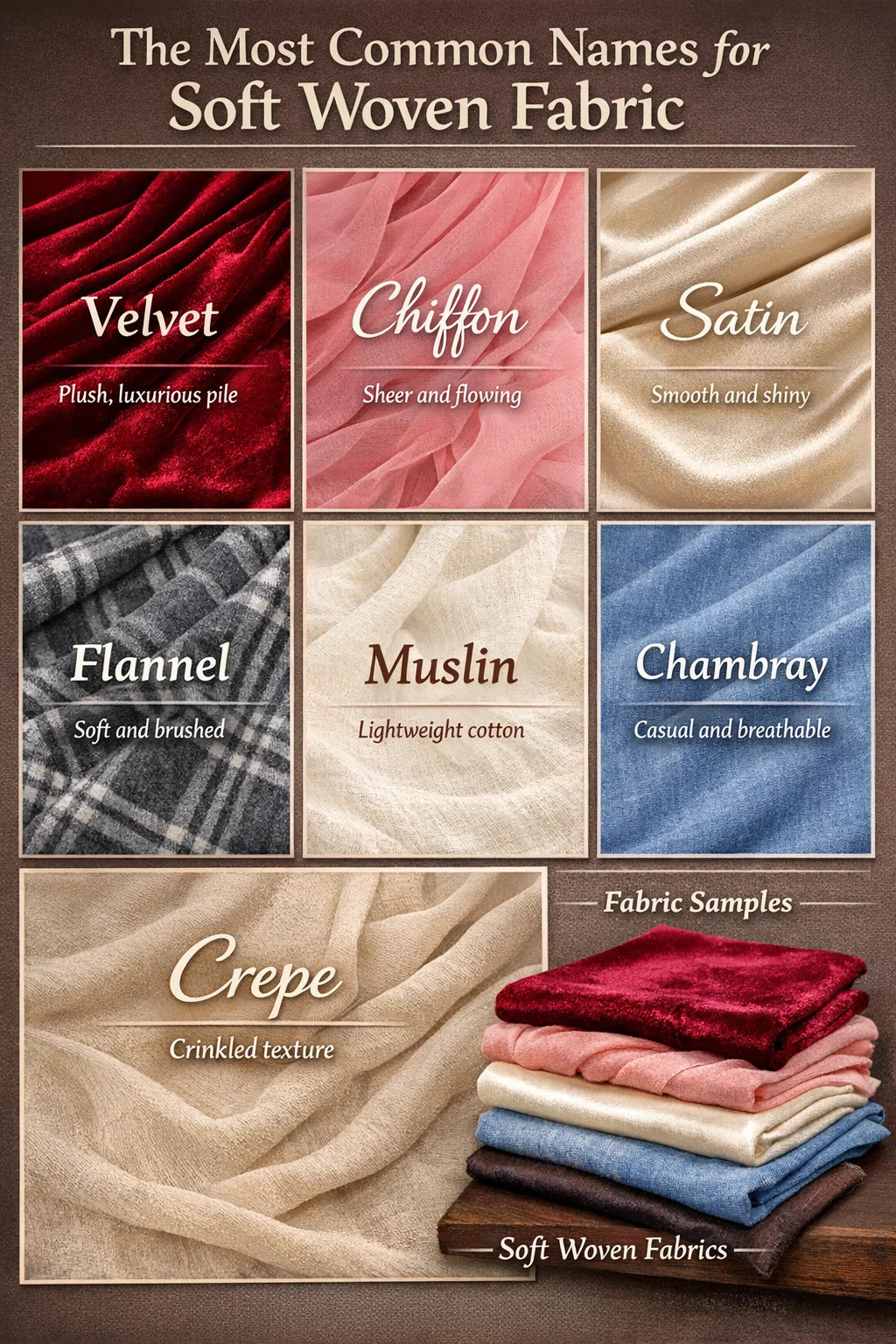
The Most Common Names for Soft Woven Fabric
When people ask "what is the name of soft woven fabric," the answer depends on the fiber content, weave structure, and finish. The most widely recognized soft woven fabrics include velvet, chiffon, satin, muslin, flannel, chambray, and crepe. Each of these is produced on a loom using interlaced threads, yet they feel completely different from one another because of how the yarns are arranged, twisted, or finished after weaving.
Velvet is perhaps the most iconic soft woven fabric, recognized instantly by its dense cut-pile surface that creates a luxurious feel. Satin-weave fabrics, such as charmeuse and duchess satin, achieve softness through a specific over-under thread pattern that floats long threads across the surface, reducing friction and creating a smooth, almost slippery hand. Flannel gets its soft character from a brushing process applied after weaving, which raises fine fibers to the surface. Chiffon and crepe derive their suppleness from highly twisted yarns and a lightweight construction.
Understanding these names is practically useful when shopping for apparel fabric, sourcing material for home décor, or selecting fabric for a sewing project. Each name signals not just a texture but also a set of care instructions, drape characteristics, and appropriate end uses.
Velvet: The Classic Name in Soft Woven Fabric
Velvet is one of the oldest and most celebrated soft woven fabrics in textile history. It is created using a special double-cloth weaving technique in which two layers of fabric are woven simultaneously, connected by pile threads. These pile threads are then cut, leaving a dense, upright surface of short fibers. The result is a fabric with a characteristic softness, a subtle sheen that shifts with light direction, and a visual depth that no printed or knit fabric can replicate.
Historically, velvet was made exclusively from silk, making it a symbol of royalty and wealth. Today, polyester, cotton, and rayon velvets are widely available at price points accessible to most consumers. Cotton velvet has a matte, heavier quality that suits upholstery and curtains, while polyester velvet is lighter and more affordable, commonly used in evening wear and costume design. Silk velvet remains the premium choice, retailing at anywhere from $40 to over $200 per yard depending on weight and origin.
Velvet Variations Worth Knowing
- Crushed velvet — pile is intentionally pressed in multiple directions, creating a textured, iridescent look
- Stretch velvet — woven with spandex or knit backing for fitted garments like leggings and bodysuits
- Burnout velvet — a chemical process removes pile in select areas, creating semi-sheer floral or geometric patterns
- Velveteen — a cotton imitation of velvet with a shorter pile, more affordable and less lustrous
- Devore velvet — similar to burnout, often used in luxury scarves and shawls
When cutting velvet, all pattern pieces must run in the same pile direction. Cutting against the pile creates a noticeable color shift, which is why experienced sewists always mark the nap direction before cutting.
Satin and Charmeuse: Soft Woven Fabrics with Silky Surfaces
Satin is not a fiber — it is a weave structure. The satin weave uses a pattern in which warp threads float over multiple weft threads before interlacing, typically in a 4-over-1 or 8-over-1 arrangement. This minimizes the number of interlacing points on the face of the fabric, which reduces friction and creates a smooth, reflective surface. The fewer the interlacing points, the softer and shinier the resulting fabric.
Charmeuse is a lightweight satin-weave fabric, almost always made from silk or polyester. It has a lustrous face and a dull, slightly crepe-like back. It drapes beautifully around the body, making it the preferred choice for lingerie, bias-cut evening gowns, and luxury blouses. Duchess satin, by contrast, is heavier and stiffer, commonly used in structured bridal gowns where body and shape retention are important.
Satin-Weave Fabric Comparison
| Fabric Name | Fiber Content | Weight | Best Use |
|---|---|---|---|
| Charmeuse | Silk or polyester | Lightweight | Lingerie, blouses, evening wear |
| Duchess Satin | Silk or polyester blend | Heavy | Bridal gowns, structured bodices |
| Antique Satin | Silk or rayon | Medium | Drapery, home décor, formalwear |
| Sateen | Cotton | Medium | Bed sheets, casual womenswear |
Sateen deserves special mention as the cotton version of satin-weave fabric. It uses the same float structure but with cotton weft threads dominating the surface. Bed sheets labeled "300 thread count sateen" use this weave to achieve a smoother, softer feel compared to percale (a plain-weave cotton). Sateen sheets feel warmer and more draping against the skin, which is why they outsell percale in colder climate markets.
Chiffon: A Lightweight Soft Woven Fabric for Flowing Garments
Chiffon is a plain-weave fabric made from highly twisted yarns, which creates a slightly rough texture at the microscopic level despite feeling soft and airy to the touch. The term comes from the French word for cloth or rag, and it has been used in fashion since the early 20th century. Silk chiffon is among the most difficult fabrics to sew because it shifts easily under a presser foot and frays aggressively at cut edges, but its fluid drape and translucent quality make it irreplaceable for formal eveningwear, scarves, and layered skirts.
Polyester chiffon is a more forgiving alternative that behaves similarly but is washable and far less expensive. It has largely replaced silk chiffon in mass-market fashion. The global chiffon fabric market was valued at approximately $2.3 billion in 2022, with polyester variants accounting for over 60% of total volume due to cost and durability advantages.
How to Identify Chiffon Among Other Soft Woven Fabrics
- Translucent or semi-sheer appearance when held to light
- Slight texture or grain visible under magnification due to twisted yarns
- Very lightweight, typically under 30 grams per square meter
- Frays readily at cut edges, requiring French seams or serged finishes
- Flows and billows with air movement, unlike denser woven fabrics
Georgette is a close relative of chiffon, also a plain-weave fabric made from twisted yarns, but with a crepe-like texture that makes it slightly heavier and more opaque. It has better drape control than chiffon, which is why it is frequently used for wrap dresses and blouses where the fabric needs to fall cleanly without clinging.
Flannel and Brushed Cotton: Soft Woven Fabrics Built for Warmth
Flannel is a plain or twill-weave fabric that has been mechanically brushed after weaving to raise fibers from the yarn surface, creating a napped finish that traps heat and feels exceptionally soft against skin. It is most commonly made from wool or cotton, though synthetic flannel using polyester is also produced. Cotton flannel, also sold as flannelette, is one of the most popular soft woven fabrics for pajamas, bedsheets, and infant clothing due to its warmth, breathability, and machine-washable nature.
Wool flannel is denser, heavier, and significantly warmer. It is the traditional choice for tailored trousers, blazers, and coats in autumn and winter collections. A quality wool flannel typically weighs between 250 and 400 grams per square meter. Heavier weights, sometimes called "substantial flannel," are used in outerwear where insulation is the priority. Lighter weights work for tailored suits.
Brushed Cotton vs. Flannel: Is There a Difference?
Brushed cotton and flannel are frequently used interchangeably, but there is a technical difference. Flannel is traditionally made from wool or wool blends and is brushed on both sides. Brushed cotton, or flannelette, is made from cotton and may be brushed on one or both sides. The softness level is comparable, but flannel has better moisture-wicking properties when made from wool, while brushed cotton is more affordable and easier to launder. For everyday bedding and loungewear, brushed cotton is the practical choice. For tailored garments meant to last a decade, wool flannel is the investment worth making.
Muslin, Lawn, and Batiste: Soft Lightweight Woven Fabrics for Fine Work
Muslin is a plain-weave cotton fabric with a relatively open structure and soft hand. It ranges from unbleached utility muslin used for making test garments (called "toiles" in couture) to finely woven Swiss muslin used in high-end blouses and infant clothing. Utility muslin is inexpensive, widely available, and invaluable in dressmaking for fitting tests before cutting into expensive fashion fabric. Fine muslin can have a thread count exceeding 200, giving it a silky, almost transparent quality.
Lawn is a step above muslin in refinement. It is a crisp, lightweight plain-weave fabric made from combed cotton or linen. The combing process removes short fibers before spinning, which results in a smoother, stronger yarn. Cotton lawn is widely used in Liberty of London's famous printed fabrics, sold for approximately £20–£40 per meter. It is the fabric of choice for heirloom sewing, christening gowns, and delicate children's clothing.
Batiste is even finer than lawn, with a softer, more fluid drape. It is made from cotton, linen, silk, or wool depending on the intended use. Cotton batiste is common in lingerie and interfacing applications. Wool batiste is a specialty fabric used in couture garments where a lightweight, breathable underlining is needed without adding bulk.
Lightweight Plain-Weave Soft Fabrics at a Glance
| Fabric | Fiber | Texture | Key Use |
|---|---|---|---|
| Muslin | Cotton | Soft, open weave | Toiles, baby clothing, utility |
| Lawn | Cotton or linen | Crisp, fine | Printed blouses, heirloom sewing |
| Batiste | Cotton, silk, wool | Soft, fluid | Lingerie, couture underlining |
| Voile | Cotton or polyester | Sheer, lightweight | Curtains, summer blouses |
Crepe: The Soft Woven Fabric with a Distinctive Crinkled Surface
Crepe refers to a family of fabrics characterized by a crinkled or pebbly surface texture. This texture results from using highly twisted yarns in alternating S-twist and Z-twist directions, from weaving techniques that cause the fabric to pucker slightly, or from chemical treatments applied after weaving. The result is a fabric with exceptional drape, moderate stretch, and a matte surface that hides wrinkles better than most other woven textiles.
Silk crepe de chine is one of the most popular soft woven fabrics in women's fashion. It is lightweight, fluid, and easy to dye, making it ideal for printed blouses, slip dresses, and fluid trousers. Polyester crepe de chine offers a nearly identical appearance at a fraction of the price and is the dominant version in today's ready-to-wear market. Wool crepe is heavier and denser, often used in tailored suits and straight skirts where structure and wrinkle resistance are both needed.
Why Crepe is a Wardrobe Staple
- The pebbly texture scatters light, which makes the fabric look less shiny and more refined in professional settings
- Its natural stretch and recovery mean garments retain their shape through a full day of wear
- Crepe is forgiving of body contours, draping away from the body rather than clinging
- It packs well for travel with minimal wrinkling compared to smooth weaves like satin or plain cotton
- Crepe is versatile across seasons — lightweight crepe for summer, heavier wool crepe for autumn and winter
Chambray and Soft Denim: Casual Soft Woven Fabrics for Everyday Wear
Chambray is a plain-weave fabric made from colored warp threads and white weft threads, creating a soft, muted appearance that resembles denim from a distance but feels entirely different in hand. Where denim is a heavy twill-weave fabric originally designed for workwear, chambray is lightweight and breathable, often weighing between 90 and 150 grams per square meter. Chambray shirts are a staple in warm-weather wardrobes precisely because the fabric breathes well, softens with washing, and has a relaxed, lived-in aesthetic without the stiffness of denim.
Soft-washed denim, while technically a heavier woven fabric, has been processed through enzyme washing or stone washing to break down stiff fibers and produce a fabric that feels much closer to chambray in softness. Brands producing premium denim often use finishing techniques that add up to 30% more softness compared to untreated denim of the same weight, measured by standard fabric hand testing methods.
Chambray vs. Denim: Key Differences
| Feature | Chambray | Denim |
|---|---|---|
| Weave structure | Plain weave | Twill weave |
| Weight | 90–150 gsm | 280–450 gsm |
| Feel when new | Soft, smooth | Stiff, structured |
| Breathability | High | Low to moderate |
| Best season | Spring, summer | All seasons |
Jacquard and Brocade: Structured Soft Woven Fabrics with Woven-In Patterns
Jacquard is not a single fabric but a method of weaving that allows complex patterns to be woven directly into the fabric structure rather than printed on the surface. The jacquard loom, invented by Joseph Marie Jacquard in 1804, uses a punch-card system (the conceptual precursor to computer programming) to control individual warp threads, creating intricate designs with multiple colors and textures. Modern computerized jacquard looms can produce designs with tens of thousands of unique thread combinations per inch.
Brocade is a type of jacquard-woven fabric with a raised pattern, typically in a contrasting color or metallic thread. The supplementary weft threads used to create the pattern float across the back of the fabric between pattern repeats. Historically made from silk with gold or silver threads, modern brocade is produced in polyester, cotton, and viscose for affordable fashion applications. Brocade is commonly used in formal jackets, cocktail dresses, and decorative upholstery.
Damask is another jacquard-woven fabric with a flat, reversible pattern created by contrasting satin-weave and plain-weave areas. Unlike brocade, damask has no raised texture — the pattern is visible because the different weave areas reflect light differently. High-quality silk damask tablecloths and napkins remain a hallmark of formal dining, while cotton damask is widely used in household linens and draperies.
How Fiber Content Affects the Softness of Woven Fabric
The softness of any woven fabric depends heavily on the fiber used to make the yarn. Natural fibers vary considerably in their inherent softness. Silk is the smoothest natural fiber, produced by silkworms in continuous filament strands that average 300 to 900 meters in length per cocoon. The smooth surface of silk filaments means there are no microscopic fiber ends to scratch or irritate skin. Cotton softness depends on staple length — long-staple cottons like Egyptian and Pima produce finer, smoother yarns than short-staple varieties.
Merino wool is widely considered the softest wool fiber available for woven fabrics, with fiber diameters below 19.5 microns for superfine grades. Standard wool feels scratchy to many people because its fibers have a scaly surface that can irritate sensitive skin. Merino wool fibers are fine enough that the scales do not register as prickle, making merino woven fabrics comfortable directly against skin in a way that coarser wool cannot match.
Among plant fibers, bamboo-derived viscose and Tencel (lyocell) are recognized for producing exceptionally soft woven fabrics. Tencel fibers have a smooth, round cross-section and a natural moisture-wicking property. Woven Tencel fabrics feel cool and buttery against skin, making them increasingly popular in bedding and activewear. Bamboo viscose is marketed heavily for its softness, though the chemical processing used to convert bamboo cellulose into fiber is similar to conventional rayon production.
Fiber Softness Ranking for Woven Fabrics
- Silk — smoothest natural fiber, no fiber ends, exceptional glide against skin
- Cashmere — fine goat undercoat fiber, 14–19 microns, incredibly soft but expensive
- Superfine merino wool — under 17.5 microns, soft enough for direct skin contact
- Tencel / lyocell — smooth fiber cross-section, cool and soft in woven form
- Long-staple cotton (Pima, Egyptian) — fine yarns, smooth hand, softens further with washing
- Bamboo viscose / rayon — soft when new, may stiffen with repeated washing
- Standard cotton — widely available, softens with use, less refined than long-staple varieties
- Polyester microfiber — engineered softness, consistent quality, but lacks breathability
Woven Fabric vs. Knit Fabric: Understanding the Difference in Soft Textiles
Woven fabric is made by interlacing two sets of yarn at right angles — the warp (lengthwise) and the weft (crosswise). This structure gives woven fabrics dimensional stability, meaning they do not stretch significantly along the grain lines. Knit fabric, by contrast, is made from a single yarn looped back on itself repeatedly, which creates a stretchy structure capable of elongating in multiple directions.
Soft woven fabrics are generally more durable and shape-retaining than soft knit fabrics of the same fiber content. A woven silk blouse will hold its form through years of wearing and dry cleaning, while a knit silk jersey garment may stretch out of shape over time. For structured garments, tailored clothing, and home textiles like tablecloths and draperies, woven fabrics are always preferred. For activewear, t-shirts, and garments requiring body-conforming stretch, knit fabrics are the practical choice.
The confusion between woven and knit arises frequently with fabrics like jersey, interlock, and fleece, which are all knit structures despite sometimes being sold alongside woven fabrics in fabric stores. A simple test: pull the fabric along its width. Woven fabric resists stretching or stretches minimally. Knit fabric stretches significantly and recovers when released. This single test eliminates most confusion when identifying unfamiliar soft fabric by hand.
Caring for Soft Woven Fabrics to Maintain Their Quality
Improper care is one of the most common reasons soft woven fabrics lose their texture, drape, or appearance prematurely. Each fabric type has specific requirements that, when followed, extend the life of the textile significantly.
Care Guidelines by Fabric Type
- Velvet: Brush with a soft velvet brush to restore the pile after wearing. Dry clean or steam carefully — never press with a hot iron directly on the pile surface, as heat flattens the pile permanently.
- Silk chiffon and charmeuse: Hand wash in cool water with a pH-neutral detergent, or dry clean. Avoid wringing. Roll in a towel to remove excess water and air dry flat or on a padded hanger.
- Flannel and brushed cotton: Machine wash on a warm gentle cycle. Tumble dry on low heat to maintain the nap. Over-drying causes flannel to pill; remove from the dryer while slightly damp.
- Crepe: Depends on fiber content. Polyester crepe is machine washable on a delicate cycle. Silk and wool crepe should be dry cleaned or hand washed with care. Steam pressing on the wrong side restores crinkle texture.
- Muslin and cotton lawn: Machine washable in warm water. Pre-wash before cutting for sewing projects, as these fabrics can shrink up to 5–8% in the first wash.
- Jacquard and brocade: Usually dry clean only due to complex weave structures. Spot clean carefully if necessary. Store flat or loosely rolled rather than folded to avoid permanent crease lines in the raised pattern areas.
Storage matters as much as washing. Fold soft woven fabrics along the grain rather than on the bias to prevent distortion. Store silk and velvet away from direct sunlight, which causes fading and fiber degradation over time. Cedar blocks or lavender sachets deter moths in wool storage without the chemical damage caused by mothballs.
Choosing the Right Soft Woven Fabric for Your Project
Selecting the correct soft woven fabric for a garment, home décor project, or craft depends on matching the fabric's properties to the end use requirements. Drape, weight, opacity, care requirements, durability, and cost all factor into this decision. Below is a practical guide organized by project type.
For Eveningwear and Formal Garments
Silk charmeuse, velvet, silk chiffon, and crepe de chine are the go-to soft woven fabrics for formal occasion dressing. Silk charmeuse drapes and moves beautifully for bias-cut gowns. Velvet adds weight and drama for cold-weather formal events. Silk chiffon layers well for overlays, sleeves, and skirts requiring lightness and movement. Wool or polyester crepe suits structured cocktail dresses that need to hold a silhouette throughout a long evening.
For Everyday Clothing
Chambray, cotton lawn, and polyester crepe are practical choices for daily wear. They are durable, relatively easy to care for, and available in a wide range of colors and prints. Cotton lawn in particular is one of the best soft woven fabrics for warm climates — it is breathable, holds printed designs sharply due to its fine, smooth surface, and softens beautifully with each wash.
For Bedding and Home Textiles
Cotton sateen and brushed cotton flannel dominate the premium bedding market. Thread count matters most in sateen and percale weaves — for sateen, a thread count between 300 and 600 represents the sweet spot between softness and durability. Above 600, the fabric often uses multi-ply yarns or poor-quality short-staple cotton inflated into high thread count claims that do not translate to better performance.
For draperies and upholstery, velvet, jacquard, and damask provide the most visual impact and durability. Cotton velvet for upholstery typically has a rub count (Martindale abrasion test) of 25,000 or higher for residential use, and 100,000 or higher for contract or commercial applications. Choosing a velvet rated below these thresholds for heavily used upholstery will result in visible pile wear within one to two years of regular use.
 PREV
PREV