English
What Is a Loosely Woven Fabric Called? Types & Uses
Content
- 1 What Is a Loosely Woven Fabric Called?
- 2 The Most Common Names for Loosely Woven Fabrics
- 3 How Weave Structure Determines Openness
- 4 Comparing Loosely Woven Fabrics Side by Side
- 5 Why Loosely Woven Fabrics Are Used in Specific Industries
- 6 The Challenges of Working With Loosely Woven Fabrics
- 7 How to Identify a Loosely Woven Fabric
- 8 Less Common Loosely Woven Fabrics Worth Knowing
- 9 Choosing the Right Loosely Woven Fabric for Your Project
What Is a Loosely Woven Fabric Called?
A loosely woven fabric is most commonly called open-weave fabric, though specific types go by distinct names depending on their fiber content, weave structure, and intended use. The most widely recognized loosely woven fabrics include gauze, cheesecloth, muslin, burlap, hessian, scrim, and leno weave textiles. What they all share is a construction where the warp and weft threads are spaced apart rather than packed tightly together, creating visible gaps or a porous surface in the finished cloth.
This open structure is not a flaw — it is a deliberate engineering choice. Loosely woven fabrics are prized for breathability, lightness, flexibility, and in many industrial applications, filtration capability. Understanding exactly which name applies to which fabric helps you select the right material whether you are sewing garments, preparing food, decorating interiors, or working on a craft project.
The Most Common Names for Loosely Woven Fabrics
Different industries use different terminology. Below are the most recognized names, each with its own characteristics and typical applications.
Gauze
Gauze is one of the oldest and most recognizable loosely woven fabrics in existence. Originally made from silk and produced in the city of Gaza — from which it takes its name — modern gauze is typically woven from cotton, though synthetic versions exist. The weave is extremely open, with threads crossing at wide intervals to produce a sheer, almost translucent cloth. Medical gauze used in wound dressings has a thread count as low as 20 threads per inch, while fashion gauze used in garments may be slightly denser but remains highly breathable. Gauze is used in surgical dressings, baby clothing, curtains, and summer apparel.
Cheesecloth
Cheesecloth is a plain-woven cotton fabric with a very loose, open structure originally developed for wrapping and pressing cheese during production. It comes in several grades ranging from Grade 10 (extremely open weave, roughly 20 threads per square inch) to Grade 90 (much finer and tighter). Despite its name, cheesecloth is used far beyond cheesemaking — it strains stocks and broths in cooking, makes Halloween costumes, serves as a polishing cloth for furniture finishing, and is used in theatrical productions as a scrim material for diffusing light.
Muslin
Muslin occupies a middle ground in the world of woven fabrics. Unbleached muslin has a relatively loose plain weave compared to tightly woven cottons like percale or canvas, though it is denser than gauze or cheesecloth. Its thread count typically falls between 80 and 140 threads per inch. It is used extensively in fashion design as a prototype fabric (called a "toile" in dressmaking), in photography as a backdrop material, in theater for scenic drops, and as a general-purpose cloth for wrapping, straining, and basic sewing projects. Historically, fine muslin from Dhaka, Bangladesh, known as "woven air," was so delicate it was sold in lengths of up to 20 meters that could fit in a matchbox.
Burlap and Hessian
Burlap (called hessian in the United Kingdom and Australia) is a coarse, loosely woven fabric made from jute plant fibers, though it is sometimes produced from hemp or flax. Its weave is open enough to allow significant air circulation, which is why it has been used for centuries to store and transport agricultural goods like potatoes, coffee beans, and grain. The open structure of burlap means moisture can escape, preventing rot during storage. In crafting and home décor, burlap has experienced a major resurgence — the global burlap and jute market was valued at over USD 1.5 billion in recent years, driven largely by demand for rustic and eco-friendly aesthetics in weddings, table runners, and wall art.
Scrim
Scrim is a lightweight, open-weave fabric used primarily in theatrical and film production, though it also appears in construction and upholstery. In theater, scrim is hung as a backdrop — when lit from the front, it appears opaque; when lit from behind, it becomes transparent, creating dramatic visual effects. Construction scrim, made from fiberglass or cotton, is embedded in plaster or drywall compound to reinforce joints and prevent cracking. Its defining characteristic is a very regular, grid-like open weave that provides structural support without significant weight or bulk.
Leno Weave Fabric
Leno weave (also called gauze weave or cross weave) is a specific weaving technique rather than a fabric type, but it produces some of the most stable loosely woven fabrics available. In leno weaving, pairs of warp threads are twisted around each weft thread, locking them in place and preventing slippage. This makes leno fabrics more dimensionally stable than plain open-weave fabrics, which can shift and distort over time. Leno-woven fabrics are used in fruit and vegetable packaging nets, specialty window screening, reinforcing fabrics, and theatrical gauze applications where durability matters.
How Weave Structure Determines Openness
All woven fabric is made by interlacing two sets of threads at right angles: the warp (running lengthwise) and the weft (running crosswise). The tightness or looseness of a woven fabric depends on several factors: thread count, yarn diameter, yarn twist, and the specific weave pattern used. Understanding these variables explains why some fabrics feel open and airy while others feel dense and opaque.
Thread Count and Yarn Spacing
Thread count refers to the number of warp and weft threads per square inch of fabric. A standard cotton bed sheet has a thread count between 200 and 400. Loosely woven fabrics sit far below this range. Cheesecloth Grade 10 has roughly 20 threads per square inch total. Even moderately open fabrics like unbleached muslin may have only 80. The lower the thread count relative to yarn diameter, the more visible space there is between threads, and the more "open" the fabric feels and functions.
Plain Weave vs. Other Weave Structures
Most loosely woven fabrics use a plain weave, where each weft thread passes alternately over and under each warp thread. This is the simplest and most open weave structure possible. Twill weaves (used in denim) and satin weaves create longer thread floats that produce tighter, denser surfaces. Plain weave fabrics can be made loose simply by spacing threads further apart during weaving, making them the natural choice for open-weave textiles.
Yarn Characteristics
Thin, loosely twisted yarns produce more open, drapey fabrics even at the same thread spacing as thicker yarns. Cotton yarns used in gauze and cheesecloth are typically combed and spun to be fine and smooth. In contrast, burlap and hessian use thick, coarse jute fibers with a natural golden-brown appearance. Both are loosely woven, but the resulting textures, hand-feel, and applications differ dramatically because of fiber and yarn differences rather than weave structure alone.
Comparing Loosely Woven Fabrics Side by Side
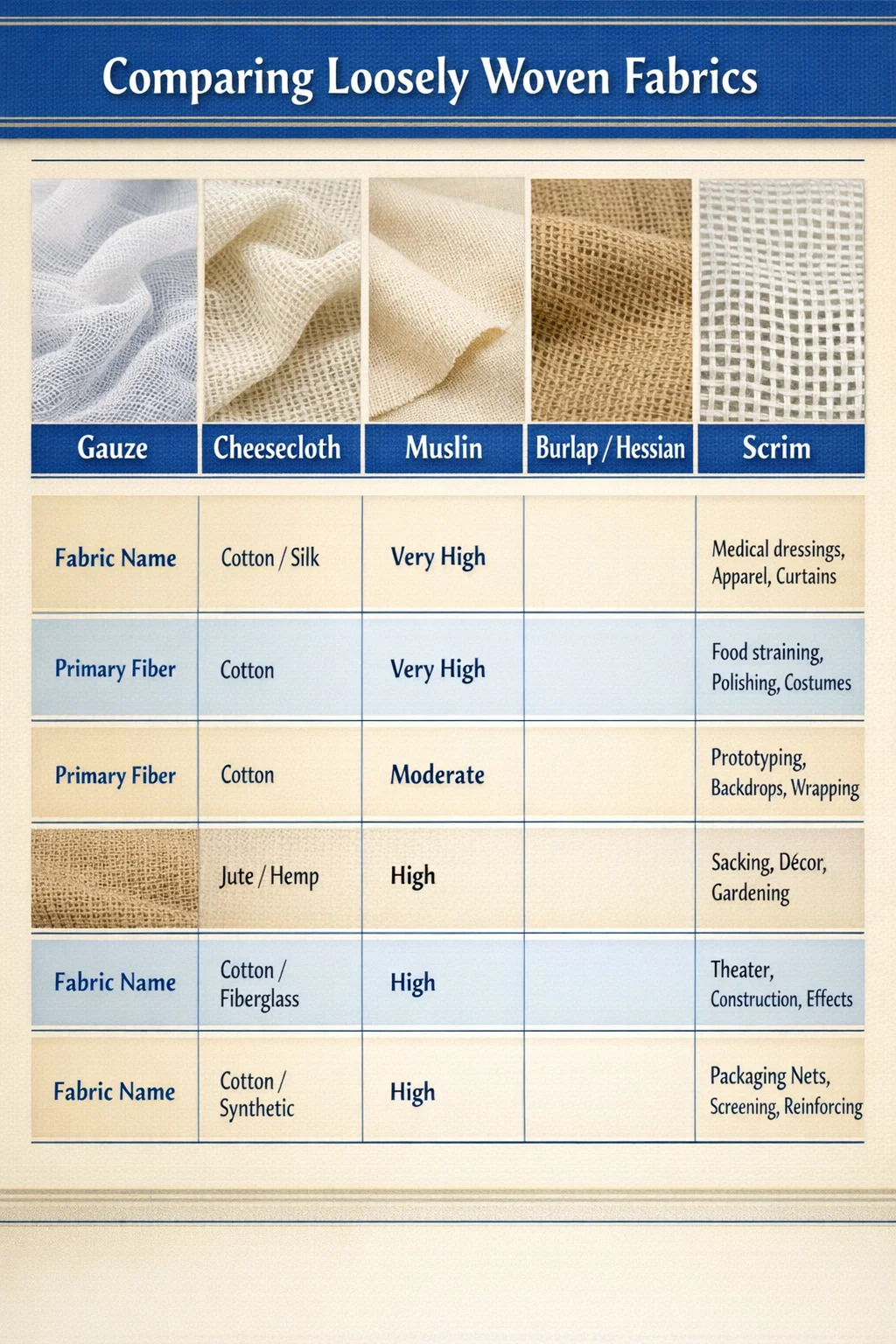
The table below summarizes the key properties and primary uses of the most common loosely woven fabrics to make selection straightforward.
| Fabric Name | Primary Fiber | Openness Level | Key Uses |
|---|---|---|---|
| Gauze | Cotton / Silk | Very High | Medical dressings, apparel, curtains |
| Cheesecloth | Cotton | Very High | Food straining, polishing, costumes |
| Muslin | Cotton | Moderate | Prototyping, backdrops, wrapping |
| Burlap / Hessian | Jute / Hemp | High | Sacking, décor, gardening |
| Scrim | Cotton / Fiberglass | High | Theater, construction reinforcement |
| Leno Weave | Cotton / Synthetic | High | Packaging nets, screening, reinforcing |
Why Loosely Woven Fabrics Are Used in Specific Industries
The open structure of loosely woven fabrics is not merely aesthetic. In many industries, that openness is the primary functional requirement, and choosing the wrong fabric density can lead to serious practical failures.
Medical and Healthcare Applications
Medical gauze is among the most critical uses of loosely woven fabric. Its open weave allows wound fluids to wick away from the wound surface while still providing a physical barrier against external contamination. The porosity also allows oxygen to reach healing tissue, which is essential for proper wound closure. Medical gauze must meet strict standards — in the United States, the United States Pharmacopeia (USP) classifies absorbent gauze by thread count, with Type I requiring a minimum of 26 by 18 threads per square centimeter. Tighter weaves would reduce fluid absorption; looser weaves would compromise structural integrity during application.
Food Production and Culinary Use
In food production, loosely woven fabrics serve as natural, food-safe filters. Cheesecloth wrapped around fresh curds allows whey to drain while holding the solid mass together during pressing. The same principle applies in home kitchens when making nut milk, straining yogurt, or clarifying stock. The specific grade of cheesecloth determines how fine the filtration is — Grade 10 will allow small particles through while Grade 90 produces a very clean, clear liquid. Chefs and food producers deliberately choose fabric openness based on what particle sizes they need to retain or discard.
Agriculture and Horticulture
Loosely woven fabrics play an important role in agriculture beyond simple sacking. Shade cloth — a loosely woven or knitted synthetic fabric — is used over crops to reduce solar radiation by specific percentages. A 30% shade cloth blocks 30% of sunlight and is ideal for hardening seedlings, while a 70% shade cloth protects shade-loving plants or livestock from intense heat. Burlap is used to wrap tree root balls during transplanting, keeping soil moist and roots intact. The open weave allows roots to breathe and water to penetrate without causing the root ball to disintegrate during handling.
Construction and Building
In construction, scrim and fiberglass mesh fabrics are embedded into plaster, stucco, and drywall compound to prevent cracking. The open weave of the mesh allows bonding compound to pass through and grip both sides of the fabric, creating a mechanical bond that dramatically improves tensile strength. Fiberglass scrim tape used over drywall joints typically has a mesh opening of around 3mm x 3mm, which is large enough to allow compound penetration but fine enough to distribute stress across a wide area and prevent crack propagation.
Fashion and Apparel
In clothing, loosely woven fabrics are selected for warm-weather garments where breathability is the primary concern. Open-weave linen, cotton gauze, and basket-weave cotton allow air to circulate close to the skin, reducing moisture buildup and discomfort in hot conditions. These fabrics are particularly popular in resort wear, summer dresses, and loungewear. The tradeoff is that loosely woven fabrics snag more easily, have lower abrasion resistance, and may require lining to prevent transparency or distortion during wear.
The Challenges of Working With Loosely Woven Fabrics
While loosely woven fabrics offer unique advantages, they also come with handling challenges that anyone working with them — whether sewing, crafting, or using them professionally — should understand before starting a project.
Fraying at Cut Edges
The most immediate challenge with loosely woven fabric is fraying. Because threads are not locked tightly together, cutting the fabric releases threads along the cut edge, and those threads continue to unravel during handling and washing. Practical solutions include using pinking shears (which cut a zigzag edge to slow unraveling), applying a liquid seam sealant like Fray Check, finishing edges with a serger or overlock machine, or turning and stitching a hem immediately after cutting. For extremely loose fabrics like cheesecloth, fraying can be severe enough that the only practical edge finish is a rolled hem or bias tape binding.
Dimensional Instability
Loosely woven fabrics are more prone to stretching, distorting, and shifting during both sewing and washing compared to tightly woven fabrics. When cutting pattern pieces from open-weave fabric, the weight of the fabric hanging off the cutting table can stretch it enough to throw pattern pieces out of alignment. The solution is to cut fabric flat on a large surface rather than allowing it to hang. During sewing, using a walking foot on the sewing machine and pinning frequently helps prevent layers from shifting. Pre-washing before cutting allows the fabric to complete its initial shrinkage — cotton gauze, for example, can shrink by up to 10 to 15% in the first wash.
Transparency and Lining Requirements
Many loosely woven fabrics are sheer or semi-transparent when used alone in garments. This is intentional in some applications — sheer curtains and layered summer blouses rely on this property — but in others, it requires lining. When constructing garments from open-weave fabric, a lining of tightly woven fabric in a matching color is often sewn inside. Alternatively, two or more layers of the open-weave fabric can be used together, which increases opacity while preserving the tactile and visual character of the material.
Needle and Thread Selection for Sewing
Sewing loosely woven fabrics requires careful attention to needle size and point type. A needle that is too large will push threads aside and create visible holes or distortion in the weave. For fine open-weave fabrics like gauze, a size 60/8 or 70/10 sharp or microtex needle works best, paired with a fine thread such as 60-weight cotton. Reducing presser foot pressure prevents the machine from dragging and stretching the fabric during stitching. Stitch length should be set slightly longer than for tightly woven fabrics — approximately 2.5mm to 3mm — to avoid perforating the fabric and weakening the seam.
How to Identify a Loosely Woven Fabric
When you encounter an unfamiliar woven fabric and want to determine whether it qualifies as loosely woven, there are several practical tests and observations that help with identification.
- Hold the fabric up to a light source. If you can see light passing through the weave structure itself (not just through the fiber), the fabric is loosely woven. The amount of light transmission roughly indicates the degree of openness.
- Use a loupe or magnifying glass to examine the weave. You should be able to see individual warp and weft threads and the gaps between them. In a tightly woven fabric, individual threads are difficult to distinguish.
- Try to push a straight pin through the fabric without piercing a thread. In a very loosely woven fabric, a pin passes cleanly between threads. In a tightly woven fabric, forcing a pin through damages the weave.
- Count threads per inch using a thread counter or ruler. Place the ruler along one edge and count how many individual threads cross one inch. Compare warp and weft directions separately. Anything under 60 threads per inch in either direction is typically classified as loosely woven.
- Pull on a corner of the fabric gently in both the warp and weft directions. Loosely woven fabrics distort and shift more easily than tightly woven ones, and you may see the threads slide against each other under tension.
Less Common Loosely Woven Fabrics Worth Knowing
Beyond the well-known names, several other loosely woven fabrics appear in specialized contexts and are worth recognizing.
Osnaburg
Osnaburg is a coarse, plain-woven cotton fabric with a somewhat loose, uneven weave due to the use of lower-grade cotton fibers. Originally produced in Osnabrück, Germany, it was historically used for sacking and work clothing. Today it is used in quilting, home décor, and as an inexpensive alternative to muslin. Its natural, undyed appearance gives it a rustic character similar to burlap but with a softer hand.
Basket Weave Fabric
Basket weave is a variation of plain weave where two or more threads are grouped together and woven as one unit, creating a pattern that resembles a woven basket. This grouping creates a slightly more open structure than single-thread plain weave at the same density. Monk's cloth and Panama weave are popular examples. Basket weave fabrics are used in upholstery, bags, and fashion because they combine visual interest with a relaxed, open drape.
Aida Cloth
Aida cloth is a stiff, open-weave fabric specifically designed for cross-stitch embroidery. It is woven with groups of threads separated by small, regular holes that guide needle placement during stitching. Aida comes in various counts — 14-count Aida has 14 holes per inch — and the openness of the weave is an intentional design feature that makes counted needlework accessible even to beginners. It is usually made from cotton or a cotton-polyester blend and comes in dozens of colors.
Tobacco Cloth
Tobacco cloth is an extremely lightweight, open-weave cotton fabric similar to cheesecloth but slightly more stable. It was originally used to shade tobacco plants from direct sunlight during cultivation. Today it appears in garment making (particularly for breezy summer tops and dresses), as a backdrop material in photography, and in theatrical applications where a very light, barely-there texture is needed. It is one of the shearest woven fabrics commercially available.
Choosing the Right Loosely Woven Fabric for Your Project
Selecting the correct open-weave fabric comes down to matching the fabric's specific properties to the demands of your application. The following questions help narrow the choice.
- Do you need filtration? If the fabric will be used to strain liquids or separate particles, cheesecloth in an appropriate grade is the standard choice. Grade the selection by what must pass through versus what must be retained.
- Do you need structural support? For reinforcing plaster, drywall, or composites, fiberglass scrim or leno weave provides the dimensional stability that plain cheesecloth lacks.
- Is softness or coarseness needed? Cotton gauze and muslin are soft against skin. Burlap and hessian are rough and coarse — excellent for rustic décor but unsuitable for direct skin contact without treatment.
- What is the exposure environment? Jute-based fabrics like burlap degrade in wet conditions over time. Cotton fabrics handle repeated washing well. Synthetic or fiberglass scrims offer the best durability in demanding construction or outdoor environments.
- Is transparency or opacity required? Theatrical scrim, gauze, and tobacco cloth are chosen specifically for light-play and sheer visual effects. If opacity is needed, muslin or a densely woven open-weave fabric is the better option.
No single loosely woven fabric is universally superior. Each name in this category represents a fabric engineered — consciously or through centuries of craft evolution — to excel in its particular domain. Knowing the full vocabulary of open-weave and loosely woven fabrics, from gauze to leno cloth, allows you to make selections based on function, not guesswork.
 PREV
PREV