English
What is a word for loosely woven fabric? Do you know?
When talking about woven fabrics with a "loose texture and large gaps," there are several very specific terms to describe them, depending on their use and appearance.
Content
Here are some of the most commonly used terms and their characteristics:
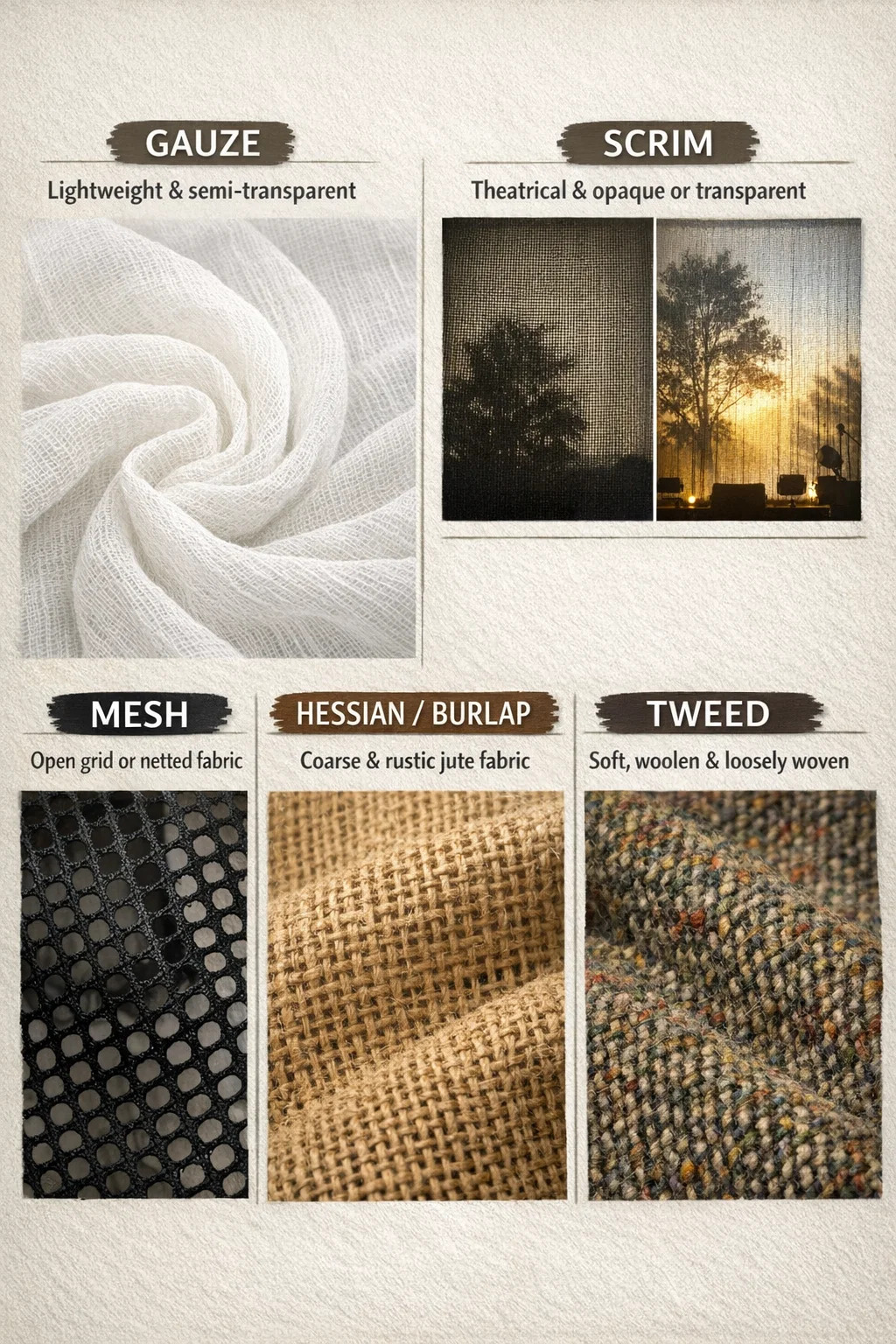
1. GAUZE
This is the first word that comes to mind when describing "loose fabric."
Structural characteristics: This fabric has large gaps between the warp and weft threads, making it semi-transparent and very lightweight.
Feel: It feels very soft to the touch and is almost weightless.
Common uses: Besides sterilized gauze used in medicine, it is often used in clothing for light summer dresses, scarves, or curtains, offering excellent breathability.
2. SCRIM
This word is common in crafts, interior design, or stage design.
Structural characteristics: It is a very light, loosely woven fabric. Due to the large gaps, it has a fascinating effect under light: opaque when lit from the front, and transparent when lit from behind.
Characteristics: Although it looks loose, it usually has a certain degree of toughness.
Common uses: Often used as a base fabric for embroidery, stage backdrops, or for reinforcing walls in construction.
3. MESH
While this word can refer to many materials, it is also very common in the textile industry.
Appearance: This fabric has noticeable "holes" or a grid pattern between the threads.
Characteristics: Its main purpose is for air circulation or to allow visibility through it.
Common uses: Breathable lining for sportswear, the back of trucker hats, or mesh bags used for washing clothes.
4. HESSIAN / BURLAP
If you're looking for a rough, loose, heavy-duty fabric, this is it.
Material: Usually made from coarse fibers such as jute, it is a very basic woven fabric.
Appearance: The threads are very thick, and the large gaps between the threads are visible to the naked eye. The color is usually earthy yellow. Common uses: Previously often used for potato sacks, now more commonly used for vintage-style decorations, tablecloths, or for wrapping plant roots in gardening.
5. TWEED (Tweed - certain specific weaving methods)
While some tweeds are tightly woven, many handcrafted tweeds are typically loosely woven fabrics.
Structure: It uses wool yarns of varying thicknesses interwoven to form a thick but not tight structure.
Texture: The surface is uneven and airy, making it very warm.
Common uses: Classic suit jackets or coats.
 PREV
PREV